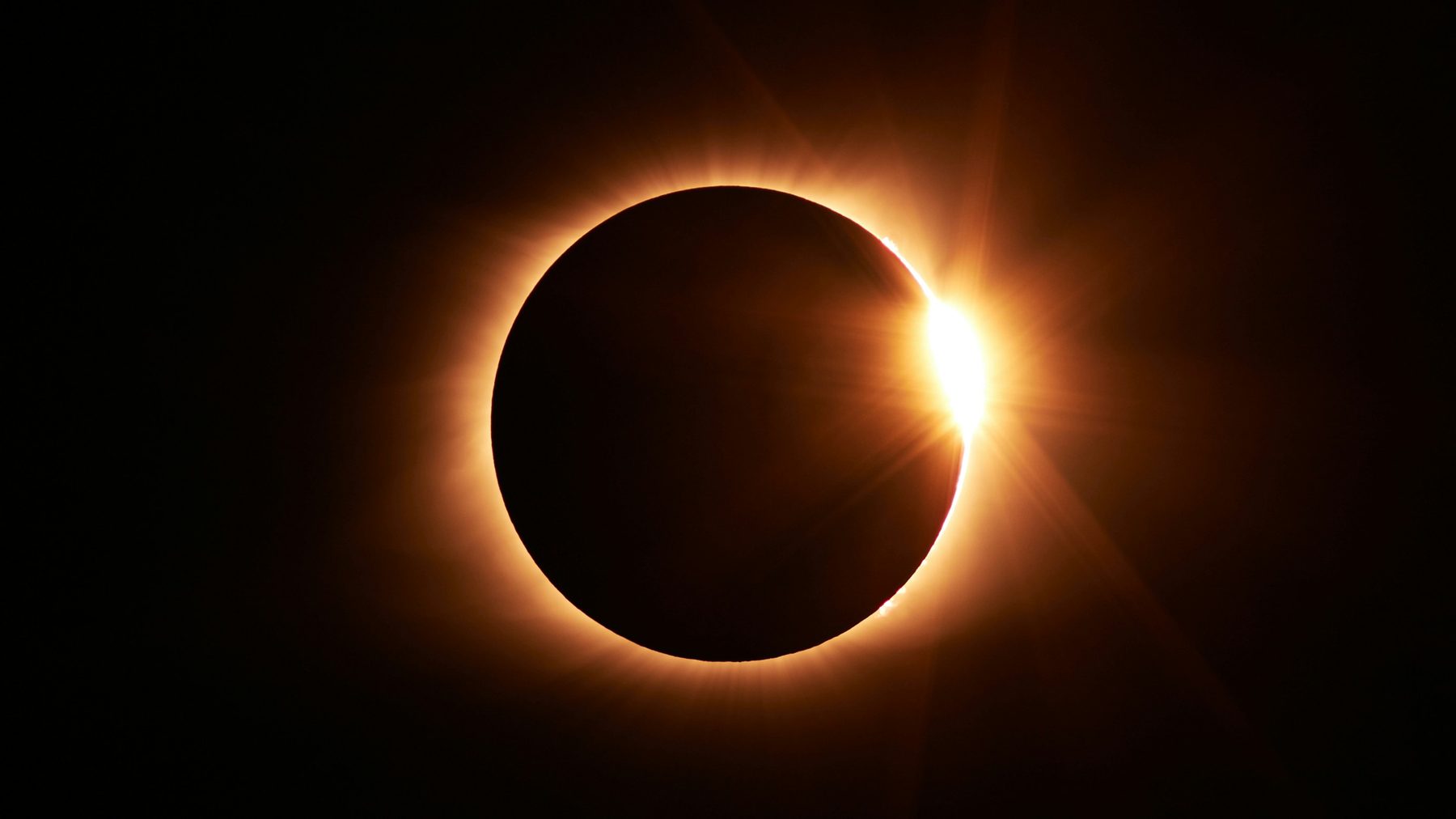
I’ve been lucky enough to see some amazing things in the sky on my travels, and standing under the northern lights in Iceland is still one of my favourite travel moments. But a total solar eclipse is the one I keep reading about, and the one on 2 August 2027 is already being called the eclipse of the century. It crosses southern Spain, North Africa and the Middle East, and in Egypt totality will last longer than anywhere else on land for decades.
I haven’t seen a total eclipse myself yet, so this is everything I’ve found out while planning, from where to go and the weather odds to booking early, eye safety and photography.
When is the 2027 solar eclipse?
The total solar eclipse is on Monday 2 August 2027. The moon’s shadow starts out in the Atlantic, reaches southern Spain and Gibraltar mid-morning, then crosses northern Morocco, Algeria, Tunisia, Libya and Egypt, before heading over Saudi Arabia, Yemen and Somalia and out into the Indian Ocean.
In southern Spain totality happens at roughly 10:45 to 10:50 in the morning local time, and in Luxor it’s around 1pm local time, with the sun almost directly overhead. The partial phases either side last well over an hour, but totality itself is only a few minutes long.
Why is it called the eclipse of the century?
It all comes down to how long totality lasts. Near Luxor it reaches about 6 minutes 20 seconds, which makes it the longest total eclipse you can easily reach on land this century, and there won’t be a longer one on land until 2114. Most total eclipses give you two or three minutes, so six is a really big deal, and the path also crosses some very sunny, easy to reach places, which doesn’t happen often.
Where can you see the 2027 total solar eclipse?
You need to be inside the path of totality, a band up to roughly 250 kilometres wide. Just outside it you only get a partial eclipse, which is interesting but nothing like the real thing, so check the maps carefully. Timings and durations below are approximate, and they get shorter the further you are from the centre line.
Southern Spain: Tarifa, Cádiz and Málaga
Spain will be the easiest option for most people travelling from the UK, with lots of flights, hotels and hire cars. Most of the province of Cádiz is in the path, along with much of Málaga province and the southern edges of Granada and Almería, but Seville is not.
Tarifa, at the southern tip of Spain, gets the longest totality in the country at around four and a half minutes. Cádiz gets roughly three minutes, and Málaga city sits nearer the edge, with under two minutes, so it’s worth heading further south and west if you can. Gibraltar and the Spanish city of Ceuta across the strait both get over four minutes as well.
Northern Morocco
Just across the Strait of Gibraltar, Tangier gets close to five minutes of totality, and Tetouan and Chefchaouen are in the path too. It’s an easy ferry ride from Tarifa or Algeciras, which makes it a good option if you want a bit longer than Spain but still want to stay close to Europe.
Tunisia
Tunisia gets over five minutes of totality in places, with excellent weather odds and more comfortable temperatures than Egypt. The Roman amphitheatre at El Jem is in the path, and it would be an amazing backdrop, although I’d expect it to be very popular.
Luxor, Egypt
Luxor is the headline spot, with around six minutes 20 seconds of totality, the sun almost overhead and some of the clearest skies anywhere on the path. Watching it among the temples of ancient Thebes will be hard to beat, and Egypt has been near the top of my own list for a long time.
The catch is the heat, as early August in Luxor regularly goes above 40°C, and it will be busy. Nile cruises and trips from Aswan are other ways to get into the path, and Cairo is outside totality altogether, so don’t base yourself there.
Saudi Arabia and beyond
The path then crosses western Saudi Arabia and the Red Sea coast, with long totality and plenty of sunshine on the coastal plain, although dust and haze can be an issue. Parts of the route through Libya, Yemen and Somalia are not realistic for most travellers right now, so always check the latest FCDO travel advice before planning anything off the beaten track.
What will the weather be like for the 2027 eclipse?
Clear sky is everything on eclipse day, and the good news is that August is one of the sunniest months along the whole route.
- Egypt and Libya have some of the best odds anywhere, with very little cloud in August in most years. The risks are dust, haze and extreme heat.
- Tunisia and Algeria also have very good odds, with low cloud cover inland.
- Southern Spain is sunny in August, especially inland, but the coast can have morning sea mist, and the levante wind around the Strait of Gibraltar sometimes brings cloud. Staying mobile with a hire car so you can move inland is a sensible plan.
- Northern Morocco is similar, with sea fog possible on the Atlantic coast and better odds a little inland.
Whichever spot you choose, check the forecast in the days before and be ready to drive an hour or two if it’s looking cloudy. It’s exactly the same approach as chasing clear skies for the northern lights.
Is there an eclipse in Spain in 2026 too?
Yes, and it’s coming up first. There’s a total solar eclipse over northern Spain on 12 August 2026, crossing places like A Coruña, Bilbao, Zaragoza, Valencia and Palma, with Madrid and Barcelona just outside the path. It happens in the early evening with the sun low in the west and totality is shorter, so a clear western horizon matters. Spain then gets another total eclipse in 2027, which is why it’s such a good place to base an eclipse trip right now.
How to book early for the 2027 eclipse
Demand for rooms in the path is going to be huge, and in Luxor lots of hotels and eclipse tours are already reported to be filling up. Southern Spain is also in peak holiday season in early August, so the sooner you plan the better.
- Book accommodation with free cancellation as early as you can, then keep an eye out for better options
- Stay a few nights, arriving at least a day or two before so a delayed flight doesn’t ruin everything
- Book a hire car early in Spain, as it gives you the freedom to move away from cloud
- Consider a specialist eclipse tour, which will handle the logistics and choose a viewing site for you
- Check visa rules and travel insurance well in advance for Egypt, Morocco or Tunisia
How to watch a solar eclipse safely
Looking at the sun without proper protection can seriously damage your eyes, and during the partial phases of an eclipse it’s never safe to look without it, even when most of the sun is covered.
- Use eclipse glasses or a handheld viewer that meets the ISO 12312-2 standard, bought from a reputable supplier, and check them for scratches or holes first
- Normal sunglasses, however dark, are not safe
- Never look through a camera viewfinder, binoculars or a telescope while wearing eclipse glasses, as the optics need their own proper solar filter fitted on the front
- Only take your glasses off once the sun is completely covered during totality, and put them straight back on as soon as the first bright point of sunlight reappears
- If you’re outside the path of totality, keep them on the whole time
- Keep a close eye on children throughout
How to photograph a solar eclipse
For the partial phases you need a proper solar filter on the front of your lens, both to protect the camera and to get a usable exposure. Use a tripod, focus manually on the edge of the sun and take a shot every few minutes to show the moon moving across.
At totality, and only then, take the filter off. The corona has a huge range of brightness, so bracket your exposures, from very short to around a second, and you can blend them later. The diamond ring just before and after totality is gone in seconds, so be ready for it.
If you’re shooting on a phone, a solar filter film over the lens works for the partial phases. I’ll be using my iPhone 17 Pro Max on my phone tripod with its Bluetooth remote, so I’m not touching it. During totality, try a wide shot showing the sky, the landscape and the people around you, as the strange light and the sunset colours all round the horizon make a far more interesting photo than a tiny sun. My guides to golden hour and blue hour photography and how to take better travel photos cover the basics of shooting in fast-changing light.
People who have seen a few eclipses nearly all say the same thing, so don’t spend all of totality behind a camera. Set something up to record automatically, and then look up.
What does totality feel like?
From everything I’ve read, it’s far more than just the sky going dark. As totality gets closer the light turns strange and flat, shadows go unusually sharp and the temperature drops noticeably. Birds often go quiet, and just before totality some people see faint rippling shadow bands on the ground.
Then the moon’s shadow races in, the last bead of sunlight flares into the diamond ring and the corona appears around a black disc where the sun was. Bright planets and stars come out, and the horizon glows orange all the way round like a sunset in every direction. People describe cheering, crying and just standing there in silence, and quite a few say they booked their next eclipse trip straight afterwards.
If you’re building a list of big travel experiences, this one is well worth adding to your travel bucket list, and with the date fixed and the best places filling up, now is a really good time to start planning.
Frequently asked questions
When is the 2027 solar eclipse?
The total solar eclipse is on Monday 2 August 2027. Totality reaches southern Spain at roughly 10:45 to 10:50 in the morning local time and Luxor in Egypt at around 1pm local time. The path crosses Spain, Gibraltar, Morocco, Algeria, Tunisia, Libya, Egypt, Saudi Arabia, Yemen and Somalia.
Where is the best place to see the 2027 eclipse?
Luxor in Egypt has the longest totality, at around six minutes 20 seconds, and some of the best weather odds on the path, although it will be very hot. Southern Spain around Tarifa and Cádiz is the easiest option from the UK, with up to about four and a half minutes, while Tunisia combines long totality with good weather.
Will the 2027 eclipse be visible in the UK?
Only as a partial eclipse. The UK is well outside the path of totality, so the moon will cover just part of the sun, and you’ll need eclipse glasses for the whole event. To see the total eclipse you’ll need to travel to southern Spain, North Africa or the Middle East.
How long will the 2027 eclipse last?
Totality lasts up to around six minutes 20 seconds near Luxor in Egypt. In Spain it’s shorter, with around four and a half minutes at Tarifa, roughly three minutes in Cádiz and under two minutes in Málaga city. The partial phases before and after totality last well over an hour in total.
Why is the 2027 eclipse called the eclipse of the century?
Because totality near Luxor lasts over six minutes, making it the longest total solar eclipse on easily reachable land this century, with no longer one on land until 2114. The path also crosses some of the sunniest and most accessible places in the world, which gives huge numbers of people a good chance of seeing it.