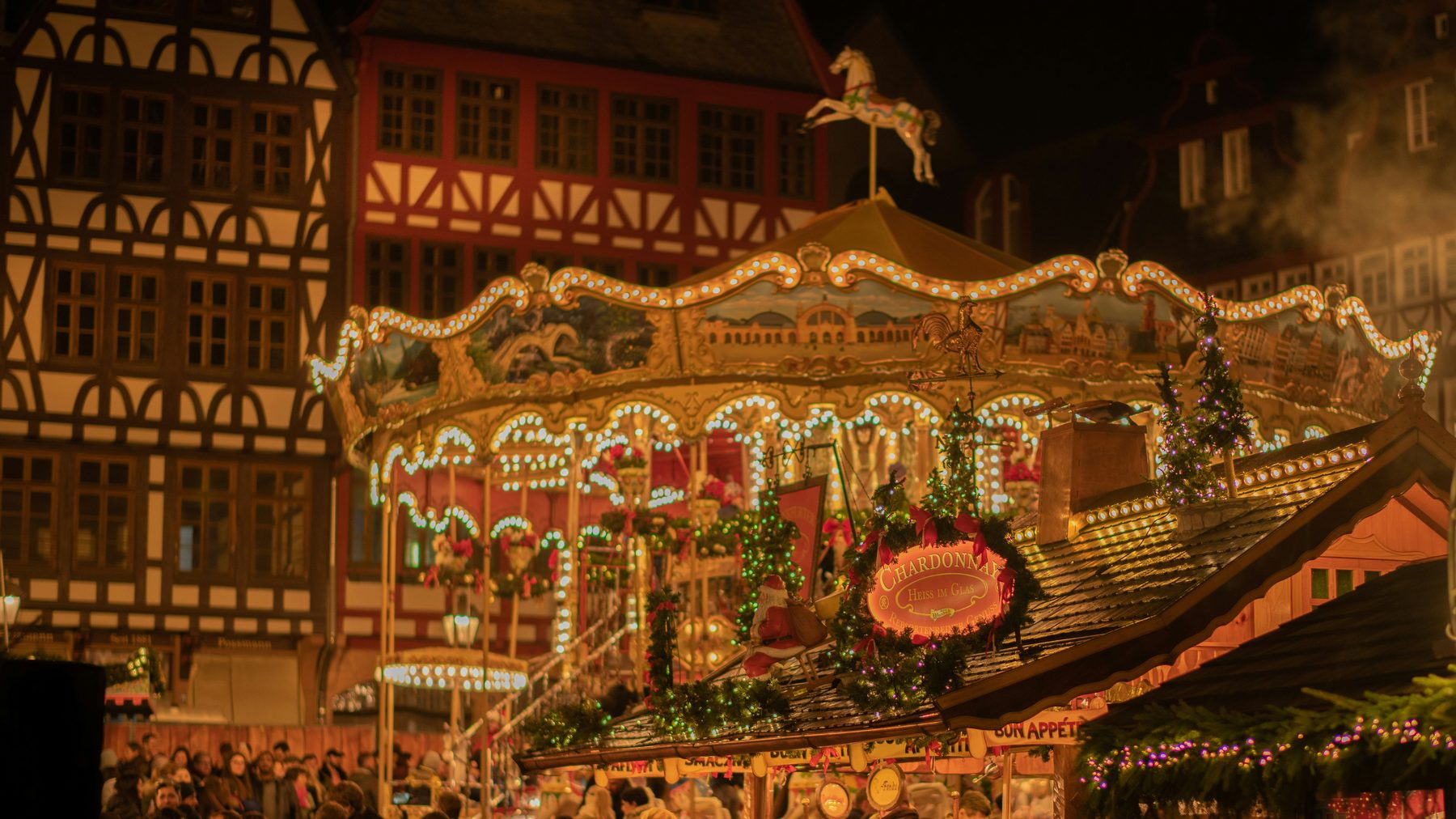
There’s something about a Christmas market on a cold evening that gets me every time, with the smell of mulled wine and sausages, the lights strung between old buildings and everyone wrapped up in hats and scarves.
Europe has hundreds of Christmas markets, and many of the best are only a short flight or train ride from the UK, which makes them ideal for a long weekend. Here are the ones I think are most worth the trip, what each one is like and some practical tips for getting the most out of them, including how to take photos that actually capture the lights.
When do Christmas markets open in 2025?
Most of the big European markets open somewhere between mid and late November and run until around 23 or 24 December. A few, particularly in Prague, Budapest, Tallinn, Copenhagen and Bruges, keep going into late December or early January. Opening times vary too, and some markets close early on Christmas Eve or shut on certain days, so always check the exact dates on the official city or market website before you book anything.
The best Christmas markets in Europe
1. Strasbourg, France
Strasbourg calls itself the capital of Christmas and has one of the oldest markets in Europe, the Christkindelsmärik, with stalls spread across several squares in the old town and a huge tree on Place Kléber. The whole centre is lit up, so it’s lovely just to walk around. Try the white mulled wine that’s popular in Alsace, bredele biscuits and a tarte flambée. It’s also the most popular market in France, so weekends are very crowded. You can reach it by Eurostar to Paris and a fast TGV onwards.
2. Colmar, France
A short train ride from Strasbourg, Colmar feels like something out of a fairytale, with half-timbered houses painted in bright colours and canals running through the Little Venice quarter. It has several small markets dotted through the old town, and it’s very easy to combine with Strasbourg in one trip. If you have an extra day, Basel’s markets on Münsterplatz and Barfüsserplatz are only a little further south, just over the Swiss border.
3. Vienna, Austria
Vienna has lots of markets rather than one, from the big one in front of the neo-Gothic Rathaus (the city hall) to the smaller, more crafty Spittelberg market and the market in front of Schönbrunn Palace. Punsch is the drink of choice here, alongside roasted chestnuts and sweet treats. With grand buildings everywhere and plenty of cafés to warm up in, it’s a really easy city for a winter break, with frequent direct flights from the UK.
4. Prague, Czech Republic
Old Town Square in Prague, with the Týn Church towering over a huge Christmas tree, has to be one of the most photogenic market settings in Europe. There’s another good market on Wenceslas Square. Try svařák (mulled wine) and grilled sausages. The trdelník pastries are everywhere, although they’re more of a tourist favourite than a Czech tradition. Prague’s markets usually run into early January, which is handy if you want to go after Christmas.
5. Nuremberg, Germany
The Christkindlesmarkt in Nuremberg is one of the most famous in Germany and is known for keeping things traditional, with red and white striped roofs on the stalls around the main square. It’s officially opened each year by the Christkind, a young woman dressed as a golden angel. Order the small Nuremberg sausages, usually three in a bread roll, and buy some Lebkuchen, the local gingerbread.
6. Cologne, Germany
Cologne has several markets, but the one in the shadow of the enormous cathedral is the one everyone photographs, with a canopy of lights over the stalls. The Old Town and Angel markets are lovely too. Try Reibekuchen (crispy potato pancakes) with apple sauce. Cologne is one of the easiest markets to reach without flying, via the Eurostar to Brussels and a high-speed train on to Cologne.
7. Dresden, Germany
Dresden’s Striezelmarkt dates back to the 1400s, making it one of the oldest in Germany, and it’s named after the Striezel, better known today as Stollen. Look out for the giant wooden Christmas pyramid and the little Pflaumentoffel figures made from prunes. Direct flights are more limited, so you may need to fly to Berlin or Prague and take the train.
8. Tallinn, Estonia
Tallinn’s market sits in the Town Hall Square in the medieval old town, surrounded by colourful merchant houses and church spires, and if you’re lucky with snow it looks incredible. It’s smaller and calmer than the big German markets. Try hõõgvein (mulled wine), gingerbread and hearty local dishes like blood sausage with sauerkraut. Being so far north, it’s dark by mid-afternoon, so the lights are on for most of the day.
9. Budapest, Hungary
Budapest’s two main markets are on Vörösmarty Square and in front of St Stephen’s Basilica, where the facade usually becomes the backdrop for a light show in the evenings. The food is some of the best of any market, with lángos (fried bread topped with sour cream and cheese), stuffed cabbage and chimney cakes. Add a soak in one of the thermal baths and you have a great winter weekend.
10. Copenhagen, Denmark (Tivoli)
Tivoli Gardens, the old amusement park in the middle of Copenhagen, is transformed for Christmas with thousands of lights, decorated trees and small market stalls, and it’s a really lovely place in the evening. You need an entry ticket, and it’s worth booking ahead. Try gløgg with raisins and almonds, and æbleskiver (little round pancakes) dusted with sugar. Nyhavn has a small market too.
11. Bruges, Belgium
Bruges is probably the easiest of all from the UK, as it’s a short train ride from Brussels on the Eurostar, or a drive from Calais or the ferry ports. The main market fills the Markt beneath the medieval belfry, and there’s a second, smaller one on Simon Stevinplein. Warm up with Belgian waffles and hot chocolate, then walk the quiet canals once the day-trippers have left.
Which Christmas markets are best for a weekend break?
For a first weekend, I’d go for a city where you can fly or take the train easily and walk between several markets. Vienna, Prague and Budapest are great value and have lots going on beyond the markets. Strasbourg and Colmar work really well together if you like the idea of travelling by train from London. Cologne and Bruges are the quickest by rail. If you want a smaller, more atmospheric market, Tallinn is a good choice.
Tips for visiting Christmas markets
- Go midweek. Weekends, especially Saturdays, can be packed at the famous markets. Weekday afternoons and early evenings are far calmer.
- Arrive as the lights come on. Late afternoon gives you daylight to look around and then the lights at dusk, before the evening crowds peak.
- Carry some cash. More stalls now take cards, but plenty of smaller stalls still prefer cash, particularly in Germany and Central Europe.
- Expect a mug deposit. At many markets your drink comes in a mug with a deposit on it. Hand it back to get your money back, or keep it as a souvenir.
- Wear layers. Standing still outside in December gets cold fast, so wear warm layers, good boots, a hat and gloves.
- Book hotels early. The popular cities fill up in December and prices rise, especially at weekends, so book as soon as you know your dates.
If you’d like more ideas for dodging the busiest times, my guide on how to avoid crowds when travelling has plenty that applies here too.
How to photograph Christmas markets
The best time for photos is blue hour, the short window after sunset when the sky turns a deep blue and balances perfectly with the warm lights of the stalls. In December that happens in the middle to late afternoon across most of Europe, so it’s easy to catch. Once the sky goes completely black, it’s much harder to get a good shot of the buildings. I’ve written more about this in my guide to golden hour and blue hour photography.
Tripods are often impractical in busy markets, so look for a wall, bin or railing to rest your camera or phone on. My iPhone 17 Pro Max handles low light really well in night mode, but it still helps to hold it steady. Get close to the stalls for detail shots, try shooting through the lights in the foreground for soft bokeh, and look for a high viewpoint like a church tower, steps or a bridge to show the whole market. For more on composition and light, have a look at how to take better travel photos.
What are the best Christmas markets in the UK?
If you’d rather not travel abroad, there are some lovely markets closer to home. Bath has wooden chalets around the Abbey and through the Georgian streets, usually for a few weeks from late November. Edinburgh fills Princes Street Gardens with a market and fairground beneath the castle, typically running from mid-November into early January. Manchester spreads its markets across the city centre and usually runs from mid-November until just before Christmas. As with the European markets, check dates before you go.
And if a winter trip has got you dreaming about where to go next, my travel bucket list ideas might give you some inspiration for the year ahead.
Frequently asked questions
What is the best Christmas market in Europe?
It depends on what you like, but Strasbourg, Nuremberg, Vienna and Prague are the most often recommended. Strasbourg has one of the oldest and largest markets, Nuremberg is famously traditional, Vienna has lots of markets in grand settings, and Prague’s Old Town Square is one of the most photogenic. For something smaller and calmer, try Tallinn or Colmar.
When do Christmas markets start in 2025?
Most European Christmas markets open between mid and late November 2025 and close around 23 or 24 December. Some, including markets in Prague, Budapest, Tallinn, Bruges and Tivoli in Copenhagen, carry on into late December or early January. Dates and opening hours vary between cities and markets, so check the official website before you book travel.
Which Christmas markets can you reach by train from London?
Brussels, Bruges and Lille are easy by Eurostar, and Cologne is a straightforward connection from Brussels on a high-speed train. Paris has its own markets, and from there fast TGV trains reach Strasbourg, with Colmar and Basel a little further on. Book early, as trains in late November and December get busy, especially on Fridays and Saturdays.
Do Christmas markets take cards?
More stalls accept cards and contactless each year, particularly in France, Scandinavia and the Baltic states. However, many smaller stalls, especially in Germany, Austria and Central Europe, still prefer cash. It’s worth carrying some local currency for food, drinks and mug deposits, and using card for bigger purchases where it’s accepted.
What is the best day to visit a Christmas market?
Weekdays, from Monday to Thursday, are usually the quietest, and late afternoon is ideal as you can see the stalls in daylight and then watch the lights come on. Saturdays are often the busiest day, particularly in December. If you can only go at the weekend, arrive early in the day or head to smaller markets away from the main square.