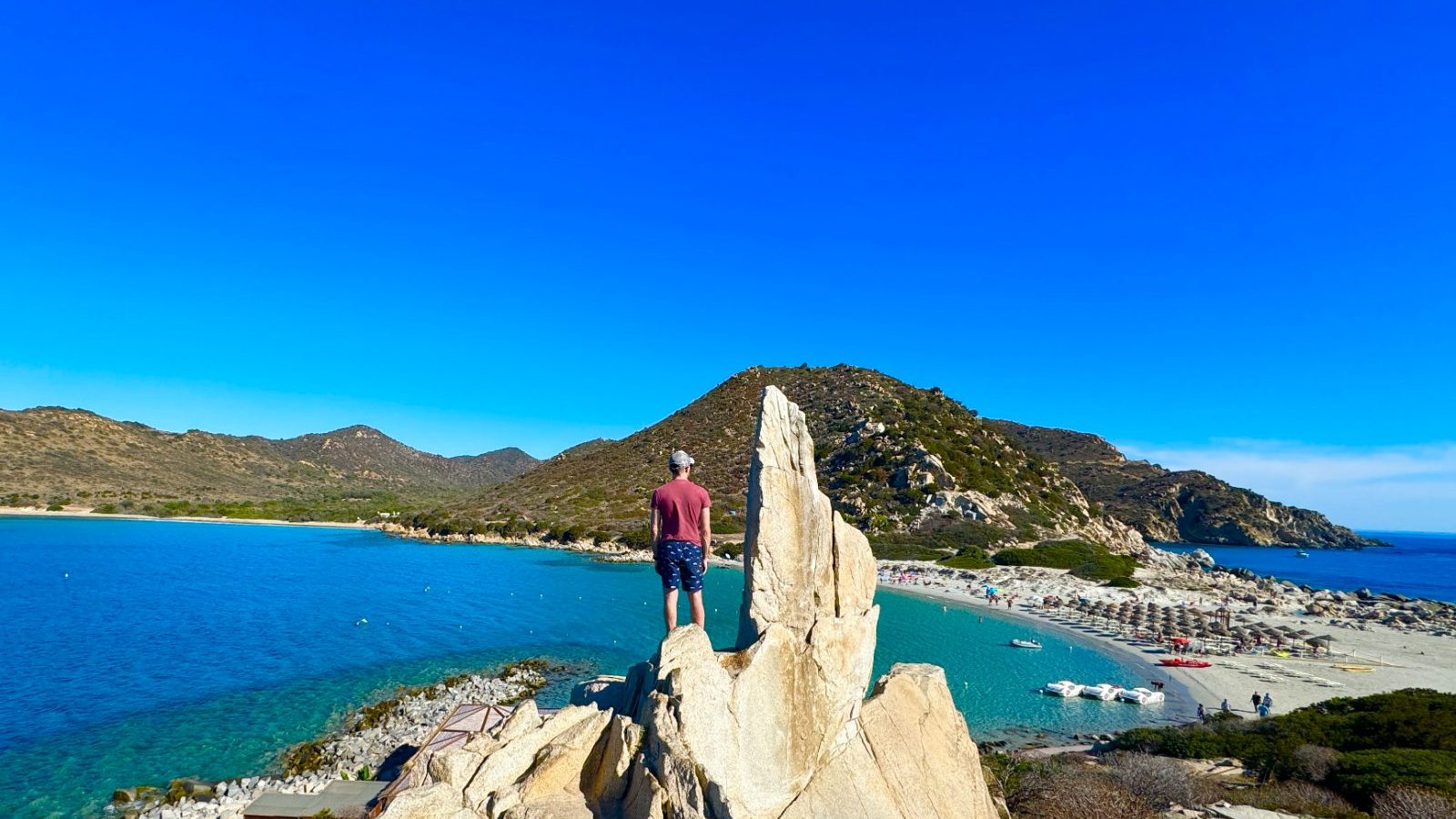
Sardinia is the second largest island in the Mediterranean after Sicily, sitting in the sea west of the Italian mainland and south of Corsica. It’s best known for its beaches, and with good reason, as the water around the coast is so clear and so turquoise that it looks unreal. Inland, it’s a rugged, wild place of granite mountains, cork oaks, sheep and ancient stone towers.
I spent a week driving the island from south to north in September, after a few days in Rome, and I’d go back in a heartbeat. This guide covers whether Sardinia is worth visiting, north versus south, the best beaches and the rules you need to know, getting around, when to go and a suggested itinerary for a 7 to 10 day Sardinia holiday.
Is Sardinia worth visiting?
Absolutely. If you love beaches and coastline, I’d put it up there with anywhere in the world. Parts of the south coast looked more like the Caribbean than Europe, with fine pale sand and water in every shade of blue and green. Add good food, friendly people, mountain roads and a history going back thousands of years, and it makes a fantastic holiday.
The one thing I’d stress is that Sardinia is much bigger than most people expect. I’d naively thought I might be able to drive round it in a day, but going from one end to the other takes the best part of a day on its own, and the coast roads are slow and winding. Plan your bases carefully rather than trying to see everything.
North or south Sardinia: where should you go?
If you only have a week and want an easy trip, pick one half and do it well. If you have 10 days or more, a one-way road trip from Cagliari in the south to Olbia in the north, or the other way round, is the way to see the best of both. That’s what I did, flying into Cagliari and home from Olbia.
South Sardinia
The south is more laid back, with long white beaches around Chia and Teulada to the west of Cagliari, and around Villasimius and Costa Rei to the east. Cagliari itself is a lively city with a historic hilltop quarter. I spent three days down here and drove both east and west along the coast, which was a lovely, relaxed change after the heat and crowds of Rome.
North Sardinia
The north-east is home to the Costa Smeralda, with its upmarket resorts, granite coves and yacht-filled harbours, plus the islands of the La Maddalena archipelago and the dramatic Tavolara Island. The north-west has a different feel, with the Catalan-influenced town of Alghero, the cliffs of Capo Caccia and the famous beach of La Pelosa near Stintino.
The best beaches in Sardinia
Tuerredda
On the south coast between Chia and Teulada, Tuerredda is a sheltered crescent of white sand and shallow, clear water with a small island just offshore. It looks like something from a film set. It’s very popular in summer and parking is paid, so get there early.
Punta Molentis
Near Villasimius in the south-east, Punta Molentis is a narrow strip of land with a beach on each side, set between two rocky headlands. The granite rocks above the bay make a great viewpoint. Access has been limited to a set number of visitors in peak season, with paid parking, so check the current rules before you go.
La Pelosa
At the north-western tip near Stintino, La Pelosa has fine white sand like talcum powder and shallow, glassy water, with an old watchtower from the late 16th century on a rocky islet just offshore. I was told to get there early, and I’m glad I did, as numbers are limited. In recent summers you’ve needed to book access in advance for a small fee, put a mat under your towel rather than laying it straight on the sand, and follow other rules to protect the beach. Check the Stintino council’s official information before visiting.
Cala Goloritzè and Cala Mariolu
On the east coast in the Gulf of Orosei, these are two of the most famous coves on the island, with white pebbles, limestone cliffs and astonishingly clear water. Cala Goloritzè is reached on foot down a steep trail from the Golgo plateau above Baunei, roughly an hour down and longer back up, and visitor numbers and fees have been introduced there too. Boats can’t land on the beach, so walking is the usual way in. Cala Mariolu is usually visited on a boat trip from Cala Gonone, Santa Maria Navarrese or Arbatax, which also stops at other coves along the gulf.
Costa Smeralda and Spiaggia Rosa
Around the Costa Smeralda, beaches such as Capriccioli, Liscia Ruja and Spiaggia del Principe are beautiful, though parking can be expensive in July and August. Further north, the famous pink beach, Spiaggia Rosa on Budelli in the La Maddalena archipelago, has been closed to visitors for decades to protect it, so you can only see it from a boat.
Sardinia beach rules you need to know
Sardinia takes protecting its beaches seriously, and it’s easy to get caught out.
- Don’t take sand, pebbles or shells home. It’s illegal, and fines can run into the thousands of euros. Bags are checked at the airports.
- Several of the most popular beaches, including La Pelosa and Cala Goloritzè, have daily visitor limits and need booking in advance in season.
- Some beaches have their own rules, such as no towels directly on the sand, no smoking or limits on what you can bring, so read the signs.
- Drones are subject to EU and Italian rules, and many coastal areas, protected parks and the airspace near airports such as Olbia are restricted. Check the official Italian drone maps before you fly.
- Take all your rubbish with you, and don’t build towers of stones or disturb the dunes.
Getting around Sardinia: do you need a car?
Yes. A hire car is essential if you want to explore, and I just couldn’t have done half of what I did without one. Public transport exists between the main towns, but it doesn’t reach most beaches at useful times, and the beauty of having a car is being able to pull over wherever the coast looks good. On my drive north, I stopped again and again to fly the drone over the coastline.
The main SS131 road links Cagliari with Sassari and Olbia and is quick, while the coastal and mountain roads are slower, twistier and far more scenic. Watch out for restricted traffic zones (ZTL) in old town centres, which can lead to fines months later, and paid parking near the popular beaches in summer. Pick up and drop off at different airports if you’re doing a one-way trip, but check the one-way fee when you book.
When is the best time to visit Sardinia?
For me, late May, June and September are the best months. The sea is warm, the beaches are calmer and accommodation is more reasonable than in high summer. I went in September and would happily go at the same time of year again. Early October can still be lovely, though some seasonal businesses start to close.
July and August are hot and very busy, especially around the Ferragosto holiday in mid-August, when Italian families flock to the coast and prices peak. Winter is quiet and mild but not really beach weather, and many resort hotels close. The north can be windy, particularly when the mistral (maestrale) blows, so it’s worth having a sheltered beach in mind as a back-up.
Where to stay in Sardinia
In the south, I rented a beach house through Airbnb for a few days, a big detached place on a hillside leading down to its own little beach, and waking up there on the first morning is something I don’t think I’ll ever forget. Private rentals like this are a great way to stay in Sardinia, especially if you’re travelling as a family or group. Villasimius and Chia are both good bases for the southern beaches.
In the north-east, I stayed at Hotel Ollastu, a four-star hotel near Olbia with a view across to Tavolara Island, and I spent my last four days there. Everywhere I went was another photo opportunity. San Teodoro, Porto San Paolo and the Costa Smeralda are all good bases in this area, while Alghero and Stintino work well for the north-west. On the east coast, Cala Gonone is the base for boat trips along the Gulf of Orosei.
A 7 to 10 day Sardinia itinerary
This route runs south to north, which is the way I travelled. It’s based on 10 days, and if you only have a week, drop the east coast or the north-west.
- Days 1 to 3: Fly into Cagliari, pick up your car and base yourself in the south. Spend a day at Tuerredda and Chia, a day at Punta Molentis and Villasimius, and an evening in Cagliari’s old town.
- Days 4 and 5: Drive up the east coast on the SS125, stopping at viewpoints, then base yourself near Cala Gonone or Baunei for a boat trip along the Gulf of Orosei or the hike down to Cala Goloritzè.
- Days 6 to 8: Continue north to the Olbia area. Visit the Costa Smeralda beaches, take a boat out to Tavolara or the La Maddalena islands and spend an evening in Porto Cervo or San Teodoro.
- Days 9 and 10: Head west for La Pelosa near Stintino, then on to Alghero and Capo Caccia before flying home from Alghero or driving back to Olbia.
What to eat in Sardinia
Sardinian food is its own thing, quite different from mainland Italy. Look out for culurgiones (stuffed pasta parcels pinched shut like an ear of wheat), malloreddus (small ridged pasta often served with a sausage and tomato sauce), fregola with clams, and porceddu, slow roasted suckling pig. Pane carasau is a crisp, paper-thin flatbread, and seadas are pastries filled with cheese and drizzled with honey. To drink, try Cannonau red wine, Vermentino white wine and a glass of mirto, a myrtle liqueur, after dinner.
Photography tips for Sardinia
The colour of the water is what makes Sardinia so photogenic, and the best way to show it is from above. Climb up to the granite rocks above a beach, or find a coastal viewpoint, and shoot down onto the bays in the middle of the day, when the sun is high and the water is at its most turquoise. Sunrise and sunset suit the wider coastal scenes, and the granite boulders of the north-east glow in the evening light. You can see my favourite shots in my Sardinia gallery, and my Rome photos from the same trip are in my Italy gallery.
You can read the full story of my trip, from the Colosseum at 3am to the last morning in the north, in my Rome and Sardinia journal. If you’re tempted by more of Italy, my Lake Como travel guide covers a very different side of the country, all mountains, villas and ferries.
Frequently asked questions
Is north or south Sardinia better?
Both are excellent, and they suit different trips. The south has long white beaches around Chia, Tuerredda and Villasimius and a more relaxed feel. The north has the Costa Smeralda, the La Maddalena islands, Tavolara and La Pelosa, with more upmarket resorts. With 10 days or more, a one-way road trip from Cagliari to Olbia lets you see both halves properly.
Do you need a car in Sardinia?
For most visitors, yes. Buses and trains link the main towns, but they rarely reach the beaches at convenient times. A hire car lets you explore the coast and stop at viewpoints along the way. The island is bigger than it looks, so allow plenty of time for drives, and watch out for restricted traffic zones in old town centres and paid beach parking.
When is the best time to go to Sardinia?
Late May, June and September are usually the best times, with warm seas, sunny weather and fewer crowds than high summer. July and August are hot, busy and expensive, especially around Ferragosto in mid-August. Early October can still be pleasant, but some seasonal hotels and restaurants begin to close. Winter is mild but not really beach weather.
Do you need to book La Pelosa beach?
In recent summers, yes. La Pelosa near Stintino has had a daily limit on visitors during the main season, with access booked in advance for a small fee. Visitors have also been required to use a mat under their towels and follow other rules to protect the sand. Arrangements can change each year, so check the Stintino council’s official information before you go.
Can you take sand from Sardinia beaches?
No. Taking sand, pebbles or shells from Sardinia’s beaches is illegal, and fines can run into the thousands of euros. Airport security checks bags, and people are caught every year. The rule protects beaches that are slowly losing sand, including famous ones like the pink beach on Budelli, so leave everything where you found it and take only photos.