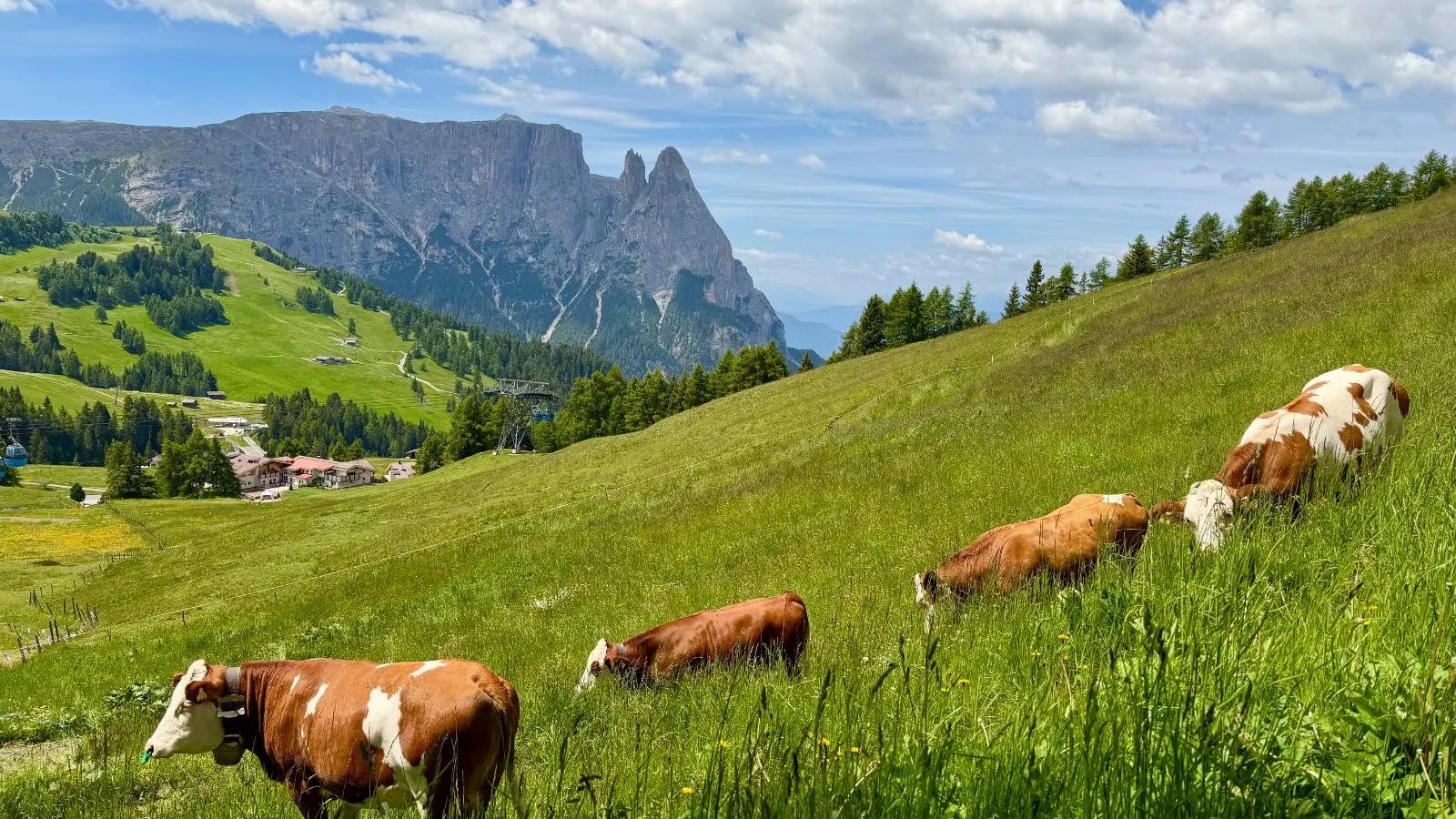
The Dolomites are one of those places that look almost too good in photos, and then you get there and it’s even better! I went in the summer and spent my days riding lifts up to ridges like Seceda and wandering across the meadows of Alpe di Siusi, with cows and horses grazing below the Sassolungo. It’s easily one of my favourite places I’ve ever photographed, and you can see some of my shots in my Dolomites gallery.
It can be a confusing place to plan though, as the mountains are spread over lots of valleys and three provinces, with Italian and German names used side by side. So this is my Dolomites travel guide, with where to stay, the best hikes, how the lifts and passes work, how to get there and when to go.
Where are the Dolomites and how do you get there?
The Dolomites are in north-east Italy, mostly in South Tyrol, Trentino and the Veneto, just south of the Austrian border. The nearest big airports are Venice, Verona and Innsbruck over in Austria, and Bolzano has a small airport right on the doorstep, although flights there are limited. From Venice it’s roughly two to three hours by road to Cortina, and from Innsbruck or Verona you can be in Val Gardena in a couple of hours or so, depending on traffic.
Bolzano is the main gateway by train, with regional buses up into the valleys. There are also direct buses from Venice airport to Cortina.
Do you need a car in the Dolomites?
You don’t strictly need one, but it makes life a lot easier. A car lets you reach trailheads before the crowds, drive the high passes like the Sella, Gardena and Giau, and move between valleys when you want to. The downside is that the passes and car parks get very busy in July and August.
The bus network is actually very good, especially in South Tyrol, and many hotels give you a guest card that includes local buses. If you’re staying in one valley and using the lifts, you can get by without a car quite happily.
Where to stay in the Dolomites
Where you base yourself makes a huge difference, as getting between valleys over the passes takes far longer than it looks on a map, so for a week I’d pick one or two bases rather than moving every night.
Val Gardena (Ortisei, Santa Cristina and Selva)
Val Gardena is where I’d send most first-timers. Ortisei is a lovely little town with plenty of places to eat, and it has lifts straight up to both Seceda and Alpe di Siusi, so you can do two of the best walks in the Dolomites without touching a car. Santa Cristina and Selva sit further up the valley and are handy for the Sella Pass and the Sassolungo.
Alta Badia (Corvara, La Villa and San Cassiano)
Alta Badia is a bit quieter, with a fantastic lift network and easy access to the Puez-Odle area and the Gardena and Falzarego passes. It’s a good central base if you have a car.
Cortina d’Ampezzo
Cortina is the big, smart resort town in the east and the best base for Tre Cime di Lavaredo, Lago di Braies, the Cadini di Misurina and the Cinque Torri. It’s the easiest to reach from Venice, but it’s also pricier and busier than the South Tyrol villages.
Val di Funes
Val di Funes is small, quiet farming country, with the little church of St Johann in Ranui and the Odle peaks lined up behind it. It’s lovely if you want peace and don’t mind driving.
Alpe di Siusi
Staying up on Alpe di Siusi itself is a real treat, as once the day visitors head down you have Europe’s biggest high alpine meadow almost to yourself for sunset and sunrise. The road up is restricted for private cars during the day in summer, so check the access rules with your hotel before you book.
Best hikes in the Dolomites
1. Seceda ridge
Seceda is the view everyone recognises, with the jagged Odle peaks rising like a wave out of green meadows. The lifts from Ortisei get you almost there, and the famous viewpoint is only a short walk from the top station. For a proper day out, walk down past the Pieralongia pinnacles towards Col Raiser and Santa Cristina. Try to get one of the first lifts up, as it gets busy by midday.
2. Tre Cime di Lavaredo loop
The loop around the three great towers is roughly 10km and takes most people three to four hours on good paths, without much steep climbing. It starts at Rifugio Auronzo and passes Rifugio Lavaredo and Rifugio Locatelli, which has the classic view of the north faces. It’s one of the best half-day walks anywhere, so expect company and go early or late.
3. Alpe di Siusi (Seiser Alm)
Alpe di Siusi is a huge high plateau of meadows and wooden hay huts, with the Sassolungo and Sassopiatto on one side and the Sciliar on the other. The walking is mostly gentle and lovely for a rest day, or you can make a longer day of it by walking towards the Sassopiatto. It’s one of my favourite places for sunrise, and it’s in my list of the best sunrise spots in the world.
4. Lago di Braies
Lago di Braies is the green lake with the wooden rowing boats and the Seekofel rising behind it. The walk around the lake is easy and takes about an hour, with a little bit of up and down on the far side. It gets extremely busy, so go first thing in the morning or in the evening.
5. Cadini di Misurina viewpoint
From Rifugio Auronzo, a path heads south towards Rifugio Fonda Savio, and after roughly 45 minutes you reach the viewpoint over the spiky Cadini peaks. The last stretch is narrow with a big drop on one side, and in peak season people queue for the famous ledge, so it’s not one for anyone uneasy with heights. It pairs well with the Tre Cime loop from the same car park.
6. Adolf Munkel trail, Puez-Odle
Starting from the Zannes car park at the head of Val di Funes, this trail runs through the forest right under the north faces of the Odle peaks, with huts like Geisler Alm (Rifugio delle Odle) for lunch. The usual loop is around 9km with a few hundred metres of climbing, so allow about three hours of walking plus plenty of time at the huts.
Lifts and passes in the Dolomites
The lifts are what make the Dolomites so accessible, and in summer most of them run from around mid June until late September or early October, with a few opening earlier, and they generally stop in the late afternoon, so always check the time of the last lift down.
If you’re planning to use lifts on most days, look at a multi-day pass. The Dolomiti Supersummer card covers a large part of the network, and some valleys like Val Gardena and Alta Badia have their own passes too. What’s included changes each year, so compare it against the lifts you actually plan to use.
Tre Cime and Lago di Braies: the peak-season access rules
The toll road up to Rifugio Auronzo for Tre Cime is closed in winter and usually opens around late May, and from summer 2025 you’re expected to book your slot online in advance through the Auronzo municipality. You can also get there by bus from Cortina, Misurina or Dobbiaco.
At Lago di Braies, the road into the valley has been closed to most traffic during the day in the height of summer, roughly July to early September, unless you’ve booked parking, come by bus or are staying at a hotel in the valley. The details can change from year to year, so always check the official Tre Cime and Braies websites before you go.
What is a rifugio, and should you stay in one?
Rifugi are the mountain huts scattered all over the Dolomites, and nearly all of them serve fantastic food.
Staying in one is the best way to be up high for sunset and sunrise, and it’s how people walk the famous hut-to-hut routes like the Alta Via 1, which is in my guide to the world’s greatest multi-day treks. Most huts open from around mid to late June until late September, and they get booked up months ahead for July and August.
- Book early and confirm by email, as many huts still manage bookings themselves.
- Bring a sleeping bag liner, which most huts ask you to use.
- Carry some cash, as not every hut takes cards.
When is the best time to visit the Dolomites?
For hiking, the best time to visit the Dolomites is from late June to September. In early June there can still be snow on the higher trails and passes, and many lifts and huts aren’t open yet. July and August are the warmest and busiest months, with afternoon thunderstorms fairly common, so start early and be off exposed ridges by early afternoon.
September is a brilliant month if you can manage it, with fewer people and often settled weather, although lifts and huts start closing towards the end of the month. In winter the Dolomites turn into one of the biggest ski areas in the world, with the Dolomiti Superski pass covering a huge network including the Sella Ronda, and the season usually runs from around December to early April. If you’re weighing up other options, have a look at my guide to summer mountain holidays in the Alps.
How many days do you need in the Dolomites?
A week is ideal for a first visit, and five days is about the minimum. With a week, split it between Val Gardena for Seceda and Alpe di Siusi, and Cortina for Tre Cime, Braies and the Cadini. Build in a spare day too, as low cloud can hide everything and it’s much better to move a big hike than do it in the mist.
Frequently asked questions
What is the best month to visit the Dolomites?
For hiking, the best months are late June to September, when the lifts and mountain huts are open and most trails are clear of snow. July and August are the busiest and warmest, with afternoon storms. September is often the sweet spot, with fewer crowds and settled weather, although lifts and huts start closing towards the end of the month.
Where is the best place to stay in the Dolomites for the first time?
Val Gardena, and Ortisei in particular, is a great first base, as lifts go straight up to Seceda and Alpe di Siusi from town. For a week, pair it with a few nights in Cortina d’Ampezzo, which is much closer to Tre Cime di Lavaredo, Lago di Braies and the Cadini di Misurina.
Do you need a car in the Dolomites?
No, but it helps. The bus network is good, especially in South Tyrol, and many hotels include local buses with a guest card, so you can manage in one valley with buses and lifts. A car makes it much easier to get to trailheads early, drive the high passes and move between valleys like Val Gardena and Cortina.
Do you need to book the Tre Cime toll road?
From summer 2025, driving the toll road up to Rifugio Auronzo is expected to need an online booking in advance through the Auronzo municipality. The road is closed in winter and usually opens around late May. You can also reach Tre Cime by bus from Cortina, Misurina or Dobbiaco. Check the official website for the latest rules before you go.
How many days do you need in the Dolomites?
A week is ideal for a first trip, and five days is about the minimum to see the highlights without rushing. Split your time between Val Gardena for Seceda and Alpe di Siusi, and Cortina for Tre Cime and Lago di Braies. Always keep a spare day, as low cloud can hide the peaks completely.