Costa Rica is the easiest country for wildlife I’ve ever been to. It’s small, the parks are well run and the guides are fantastic, and in one trip you can go from Caribbean rainforest to Pacific beaches and misty cloud forest. Around a quarter of the country is protected in some way, and you really notice it.
That said, the animals don’t line up on the path waiting for you, as sloths look like clumps of leaves and the frogs mostly come out after dark. In this guide I’ll go through where to see the main species, the best places to base yourself and when to go.
Where can you see sloths in Costa Rica?
The good news is almost anywhere with lowland or mid-elevation forest. Costa Rica has two species, the brown-throated three-toed sloth, which moves (slowly!) during the day, and Hoffmann’s two-toed sloth, which is mostly nocturnal. The three-toed ones are the sloths you’ll see curled up in the fork of a cecropia tree, often out on the branches where the sun hits.
These are the places I’d say are most reliable.
- Manuel Antonio: three-toed sloths inside the park and along the road down to the beach.
- Cahuita and Puerto Viejo: the coastal trail at Cahuita is one of the best sloth walks in the country.
- Arenal and La Fortuna: keep an eye on roadside trees, lodge gardens and the hanging bridges.
- Tortuguero: from the canals by boat, often draped over branches above the water.
- Monteverde: two-toed sloths on guided night walks.
Scan the trees for a still, rounded shape up high, ideally on a cooler morning after rain when they climb up to warm themselves in the sun.
Costa Rica wildlife by animal
Red-eyed tree frogs and poison dart frogs
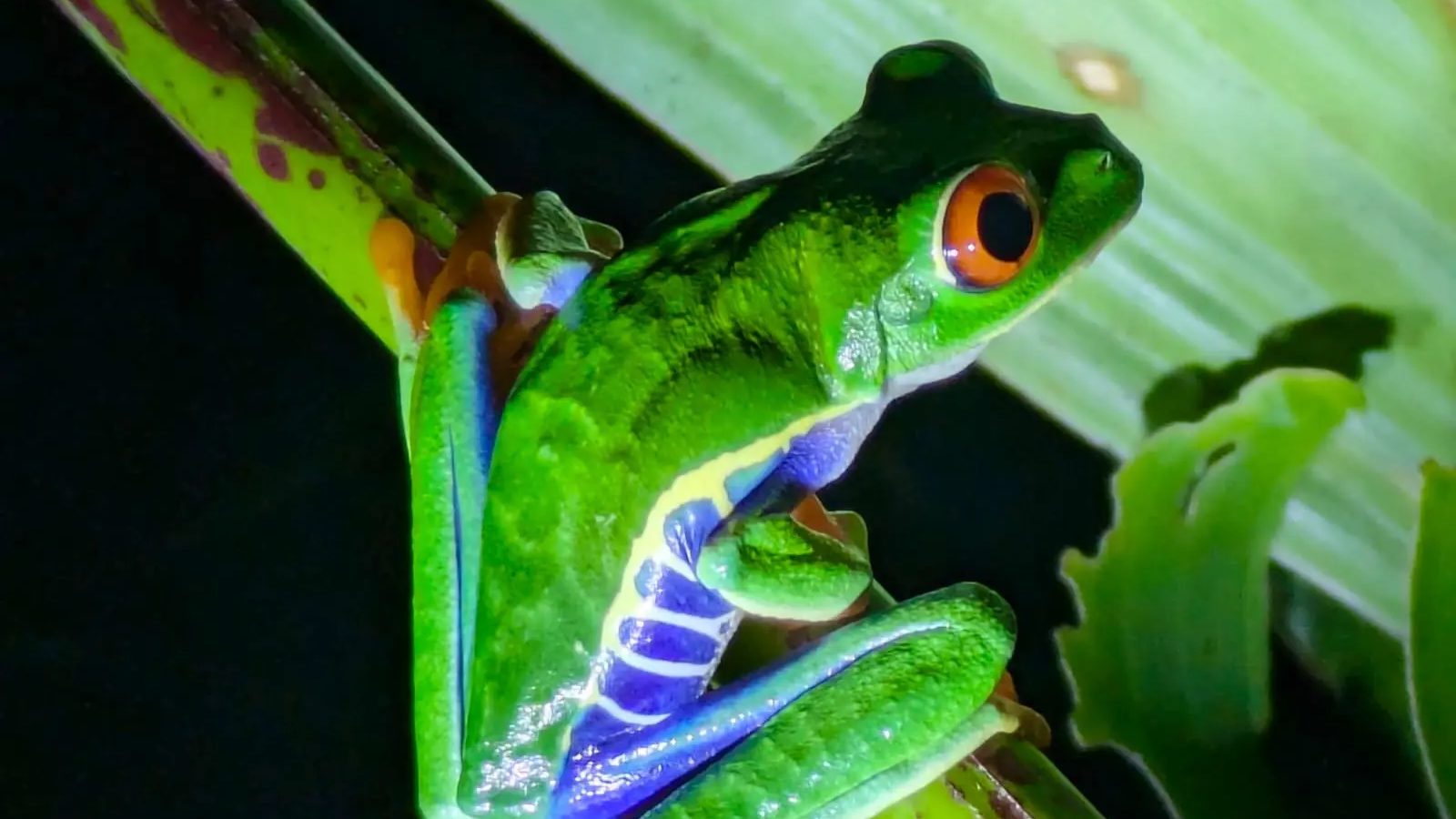
Red-eyed tree frogs are nocturnal and live in the lowland rainforest, so you’ll find them on night walks around La Fortuna, Sarapiquí and Tortuguero. The tiny red and blue strawberry poison dart frog (the so-called blue jeans frog) is common during the day on the Caribbean side, and down on the Osa Peninsula you can look for green and black poison frogs on the forest floor.
Sea turtles
Tortuguero is the classic place. Green turtles nest there roughly July to October, and leatherbacks come earlier in the year, roughly March to May, although in much smaller numbers. Night nesting tours only run with certified local guides in small groups, with no torches or phone screens on the beach. Over on the Pacific side, Ostional is famous for its mass olive ridley nestings (called arribadas), which are usually busiest in the second half of the year.
Toucans and scarlet macaws
Keel-billed toucans are common in the Caribbean lowlands and around Arenal, and the larger yellow-throated toucan turns up on both coasts. For scarlet macaws, head to Carara National Park on the central Pacific or the Osa Peninsula, where you’ll hear them squawking long before you see the flash of red.
The resplendent quetzal
This is the bird a lot of birders come to Costa Rica for. Your best chance is San Gerardo de Dota, a cloud forest valley high in the Talamanca mountains, where local guides know which wild avocado trees the quetzals feed in, and Monteverde is the other option. They’re around all year, but in the breeding season, roughly February to May, the males show off their amazing long tail streamers.
Monkeys
There are four species. You’ll hear the mantled howlers at dawn whether you like it or not, plus white-faced capuchins, Geoffroy’s spider monkeys and, only on the southern Pacific side, the Central American squirrel monkey. Manuel Antonio and Corcovado can give you all four.
The best places to see wildlife in Costa Rica
Manuel Antonio
A small park with so much packed in, with sloths, capuchins, squirrel monkeys and iguanas as well as white-sand beaches. It’s also the busiest park in the country, with daily numbers capped and tickets sold online, so book ahead, check current opening days and be at the gate when it opens. The first hour is quieter and the animals are more active.
Monteverde
Cloud forest and hanging bridges, and some of the best night walks in the country. The main reserves get crowded by mid-morning, so either go early or try one of the quieter reserves nearby. It’s cool up there and often damp, so bring a layer.
Arenal and La Fortuna
A really good all-rounder with the volcano as a backdrop. The hanging bridges put you at canopy height for birds and the odd eyelash viper, and the town makes an easy base for night walks. Caño Negro, a couple of hours north, is excellent for waterbirds and caimans.
Tortuguero
You can only get here by boat or small plane, which is a big part of what makes it special. Early morning trips along the canals by canoe or small electric boat can bring sloths, monkeys, herons, kingfishers and caimans, and river otters if you’re lucky. If you can, come in turtle season.
Osa Peninsula and Corcovado
This is the wildest corner of Costa Rica and your best chance of tapirs, all four monkeys and scarlet macaws in one place. You have to enter Corcovado with a certified guide, and overnight stays at the Sirena ranger station need booking well in advance. Drake Bay or Puerto Jiménez make good bases, and always check the latest park rules before you go.
Cahuita
A laid-back Caribbean village with a coastal trail through the national park, where you can see sloths, howlers, raccoons and vipers coiled up on branches, and there’s a reef for snorkelling too. It goes really well with Puerto Viejo and has a completely different feel from the Pacific side.
San Gerardo de Dota
Chilly and quiet, a couple of hours south of San José, and the place to come for quetzals, hummingbirds and trout streams. I’d definitely book an early morning quetzal walk with a local guide here.
When is the best time to see wildlife in Costa Rica?
The dry season, roughly December to April, is the most popular time to go. Travel is easier and the Pacific side is reliably sunny, but it’s also the busiest and priciest time, so book lodges early.
The green season, roughly May to November, is really underrated. Mornings are often bright with rain in the afternoon, the forest is lush, prices come down and it’s turtle season at Tortuguero. September and October are the wettest months on much of the Pacific side but often among the drier ones on the Caribbean coast, so plan your route around that. When I was in Costa Rica, the rain just became part of the day, so I’d head out early and be back under cover by mid-afternoon.
Are night walks in Costa Rica worth it?
Absolutely, and I’d put one on every itinerary. So much of the rainforest wakes up after dark, and on a good walk you might see red-eyed tree frogs, glass frogs, tarantulas, stick insects, sleeping birds, snakes and two-toed sloths. Monteverde, La Fortuna, Drake Bay and Tortuguero all have good guided options.
Wear closed shoes and long trousers, bring a head torch and step where your guide steps. A good guide won’t shine a light in an animal’s eyes for long and won’t pick anything up just to get you a photo.
Should you hire a wildlife guide in Costa Rica?
Yes, at least for your first morning in each area. Costa Rican naturalist guides are some of the best in the world, and they’ll spot a viper you’d have walked straight past, and most carry a spotting scope too.
Look for guides certified by the tourism board, and book through your lodge or a local operator rather than whoever approaches you at the gate.
How to watch wildlife ethically in Costa Rica
Costa Rica’s wildlife is only as good as it is because it stays wild, so there are a few simple rules I’d always follow.
- Never feed the animals. Capuchins and coatis that get human food become aggressive and ill, so keep your snacks sealed in your bag.
- Don’t hold sloths. Avoid any tour or “sanctuary” offering sloth cuddles or photos with animals, as genuine rescue centres don’t allow handling.
- Keep your distance and let the animals move away. If a sloth changes direction because of you, you’re too close.
- Turtle beaches: no flash, no torches and no selfies with nesting turtles. Do exactly what your guide says.
- Drones: most national parks don’t allow them, so check the rules before you fly.
I’ve written more about the photographer’s side of this in how to photograph wildlife ethically.
A simple wildlife route for a first trip
With two weeks, a loop covering most habitats would be to fly into San José and spend two or three nights in Tortuguero, then on to Arenal and Monteverde, down to Manuel Antonio, and finish on the Osa Peninsula if you have time. If you’ve got less time, Arenal, Monteverde and Manuel Antonio make a really good ten days.
You can see it all through my lens in the Costa Rica gallery, and if Costa Rica has got you hooked, my guide to the best places in the world to see wildlife is a good one to read next. The full routes, lodges and costs from my trip are in Base Camp.
Frequently asked questions
Where is the best place to see sloths in Costa Rica?
Manuel Antonio, Cahuita and the Arenal area around La Fortuna are the most reliable places to see sloths in Costa Rica, and the canals at Tortuguero are excellent from a boat. Three-toed sloths are active by day, often high up in cecropia trees. For two-toed sloths, which are mostly nocturnal, join a guided night walk in Monteverde or La Fortuna.
When is turtle nesting season in Tortuguero?
Green turtles nest at Tortuguero roughly July to October, which is the main season and the best time for a night nesting tour. Leatherbacks nest earlier, roughly March to May, in smaller numbers. Tours only run at night with certified local guides and there are strict rules on lights and phones, so book through your lodge and check the current arrangements.
What is the best month to see wildlife in Costa Rica?
Wildlife is good all year round. The dry season, roughly December to April, gives you the easiest travel and sunny Pacific beaches, while the green season, roughly May to November, brings lush forest, fewer visitors and turtle nesting at Tortuguero. For quetzals, roughly February to May is best, and September and October are often drier on the Caribbean coast.
Do you need a guide in Costa Rica national parks?
In most parks a guide is optional but I’d really recommend one, as you’ll see far more with someone who knows where to look and carries a spotting scope. Corcovado on the Osa Peninsula is the main exception, where you have to go with a certified guide. Rules can change, so check with the official park authority (SINAC) before you go.
Where can I see a quetzal in Costa Rica?
San Gerardo de Dota, a cloud forest valley in the Talamanca mountains, is the most reliable place, followed by Monteverde. Book an early morning walk with a local guide, who will know which wild avocado trees the birds are feeding in. Quetzals are there all year, but the breeding season, roughly February to May, is the best time to see them.
Is it safe to touch sloths in Costa Rica?
No, and you really shouldn’t try. Handling stresses sloths, can injure them and spreads disease both ways. Wild sloths should be watched from a distance, and good rescue centres don’t let visitors hold them. Avoid any tour, roadside stop or sanctuary offering sloth photos or cuddles, as that trade depends on taking animals from the wild.