Nothing quite prepares you for your first few minutes in Vietnam. When I was dropped off outside my hotel in Hanoi, I was hit by a wall of mopeds, horns, street food smells and noise, and I had to take a leap of faith just to cross the road. Within a day I was hooked. It’s colourful, full of life, the food is brilliant, the scenery goes from limestone islands to paddy fields to lantern-lit rivers, and the people were so kind.
I travelled the length of Vietnam earlier this year, from Hanoi in the north to Saigon and the Mekong Delta in the south, as the first part of a three-week trip that went on into Cambodia and Thailand. This guide covers when to go, visas, how long you need, a two-week route, getting around, money and staying safe, with a few photo tips from the road.
When is the best time to visit Vietnam?
Vietnam is long and thin, stretching well over 1,500 kilometres from north to south, so the weather varies a lot from one end to the other. There isn’t one perfect month for the whole country, but there are good compromises.
- The north (Hanoi, Ha Long Bay, Ninh Binh) has a cool, often grey winter from roughly December to March and a hot, humid, rainy summer. Spring and autumn are the most pleasant.
- The centre (Hue, Hoi An, Da Nang) is usually best from around February to August. The rainy season runs roughly September to December, when typhoons and flooding in Hoi An are possible.
- The south (Ho Chi Minh City, the Mekong Delta) is hot all year, with a dry season from about December to April and a wet season from May to November, when heavy downpours tend to come in short bursts.
For a north to south trip, February to April is hard to beat, which is when I went. Do check when Tet, the Lunar New Year, falls. It’s late January in 2025, and around it transport gets booked up and many businesses close for a few days.
Do you need a visa for Vietnam?
At the time of writing, British passport holders can visit Vietnam visa-free for up to 45 days, and for longer stays there’s an e-visa valid for up to 90 days. Rules change, so check the latest entry requirements on the GOV.UK foreign travel advice page before you book. If you need an e-visa, apply only through the official government portal, as there are lots of copycat sites that charge extra. Your passport should also have at least six months’ validity left.
How long do you need in Vietnam?
Two weeks is a good amount of time for a first trip from north to south, covering the big highlights without spending every other day in transit. With 10 days, I’d fly between the main stops and skip either Hue or the Mekong Delta. With three weeks or more, you can slow down, add Ninh Binh, the mountains around Sapa or the Phong Nha caves, or carry on into Cambodia as I did.
A two-week Vietnam itinerary, north to south
This is close to the route I followed, mostly on a small-group tour of 16 people, after a couple of days in Hanoi on my own. You can easily do it independently, too.
Hanoi (2 to 3 days)
The capital is chaotic, fascinating and full of character. Take a cyclo ride round the Old Quarter (agree the price first, as my rider was keen to renegotiate halfway round), then head out to West Lake for the Tran Quoc Pagoda, and on to the One Pillar Pagoda and the Ho Chi Minh Mausoleum. Hanoi’s Train Street, where trains squeeze between the houses, is a famous photo spot, but access has been restricted on and off for safety, so check the current situation and follow any police instructions.
Ha Long Bay (1 to 2 days)
Thousands of limestone islands rising out of emerald water make Ha Long Bay one of the most famous sights in Asia, and a UNESCO World Heritage Site. An overnight cruise is the way to do it. Ours was on a traditional-style junk boat with cosy cabins, and sailing out among the islands was one of the highlights of the whole trip. We also climbed up to Sung Sot, the Surprise Cave, which is enormous inside. If you want somewhere quieter, nearby Lan Ha Bay is often suggested.
Ninh Binh (optional, 1 to 2 days)
Often called Ha Long Bay on land, Ninh Binh is a couple of hours south of Hanoi, with rowing boat trips through limestone karsts, caves and rice fields at Trang An and Tam Coc. I didn’t have time for it, but it’s high on my list for next time.
Hue (1 to 2 days)
The old imperial capital sits on the Perfume River in central Vietnam. We took the night train from Hanoi, which took around 13 hours in a four-berth cabin, and while it wasn’t the most comfortable night’s sleep, it’s an experience in itself. In Hue, visit the Imperial City, the royal tombs, the Thien Mu Pagoda and the Thanh Toan covered bridge. One of my favourite days of the trip was a half-day motorbike tour through the paddy fields to the Thuy Xuan incense village, riding pillion behind local drivers.
Hoi An and Da Nang (3 days)
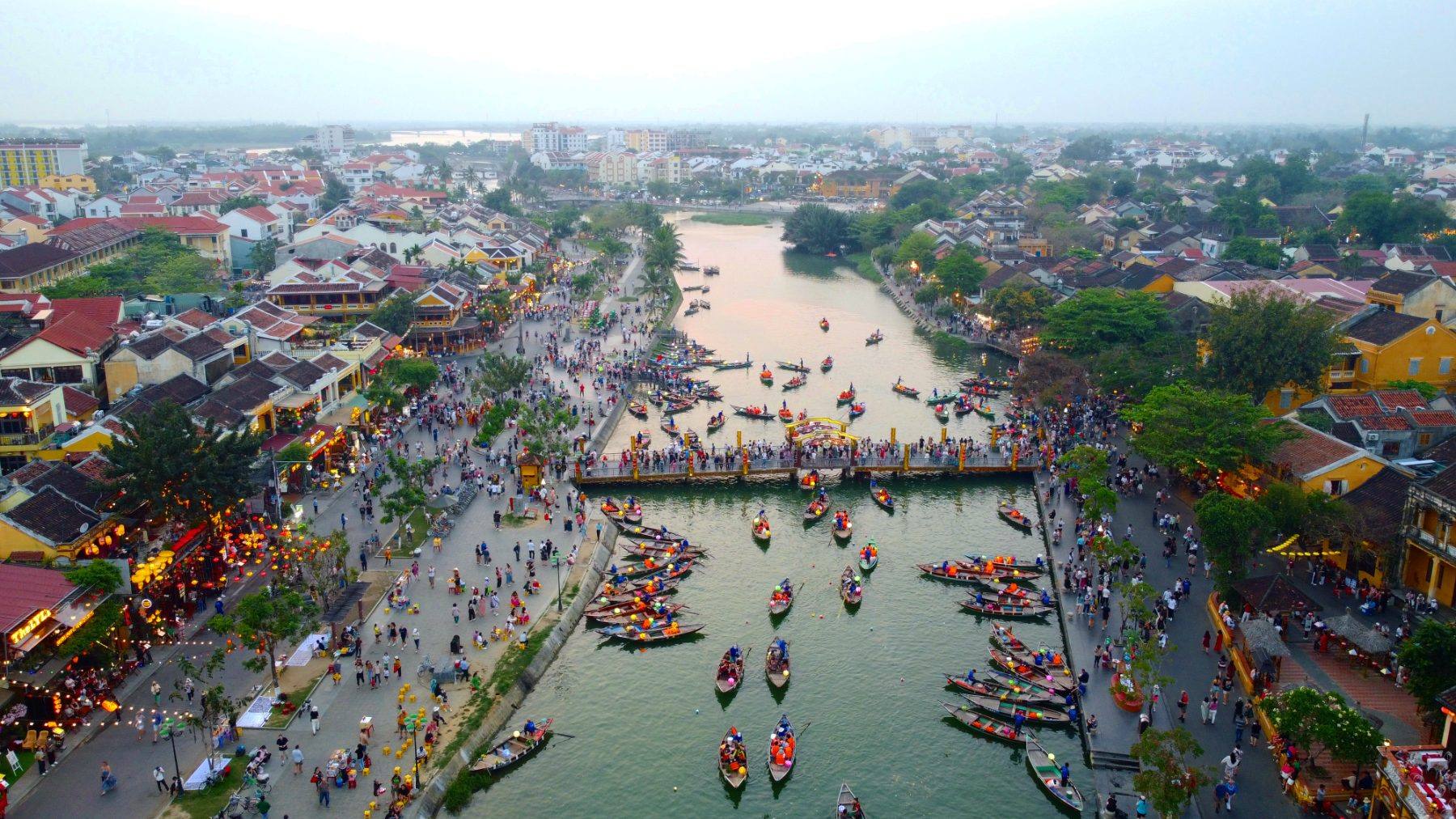
Hoi An was my favourite place in Vietnam. The old town is a UNESCO-listed trading port of yellow shophouses, and at dusk the Thu Bon River and the streets fill with coloured lanterns. Walking those streets as the sun went down and releasing a wish lantern onto the river is something I’ll never forget. By day, hire a bike and ride out through the paddy fields, or take a basket boat through the Water Coconut Forest, which was great fun.
From Hoi An, take a day trip to the Ba Na Hills above Da Nang. A long cable car ride lifts you up above the clouds to the Sun World resort and the Golden Bridge, held up by two giant stone hands. I went in with no expectations and it turned out to be one of the best days of the trip. Hue to Hoi An took us around four hours by bus. If you travel between them by car or motorbike, the Hai Van Pass is a famously scenic stretch of coast road.
Ho Chi Minh City and the Mekong Delta (3 days)
We flew from Da Nang to Ho Chi Minh City in around an hour. Most locals still call it Saigon. It’s a big, fast-moving city, and the history here is sobering. The War Remnants Museum is hard going but important, and the Cu Chi Tunnels show how people lived and fought underground during the war. Finish with a day in the Mekong Delta. We took a boat trip around the islands in the river, which shows you a completely different, slower side of Vietnam.
Getting around Vietnam
Domestic flights are cheap and quick and save a lot of time on the long legs, such as Hanoi to Da Nang or Da Nang to Ho Chi Minh City. Sleeper trains run the length of the country, and sleeper buses cover most routes, both slower but cheaper and a good way to see the countryside. In the cities, ride-hailing apps such as Grab are the easiest way to get a car or motorbike taxi at a fixed price.
Travelling on a small-group tour is a great option if it’s your first time in Asia or you’re travelling solo. Everything is organised for you, you have a local guide to explain the history, and you get instant travel companions. Going independently gives you more freedom and is very doable, as Vietnam has a well-worn backpacker trail and plenty of accommodation.
Vietnam budget and money
Vietnam is excellent value. Street food dishes often cost a couple of pounds or less, local beer is cheap, and comfortable mid-range hotels cost a fraction of what you’d pay in Europe. The currency is the Vietnamese dong, at well over 30,000 to the pound at the time of writing, so double check the zeros before handing over notes. Cash is king in markets and street stalls, while hotels and bigger restaurants usually take cards. ATMs are easy to find in towns, but many charge a fee.
What to eat in Vietnam
The food alone is a reason to go. Try pho (noodle soup) and bun cha (grilled pork with noodles) in Hanoi, along with the famous egg coffee. In Hue, look for bun bo Hue, a spicy beef noodle soup. Hoi An has cao lau noodles and some of the best banh mi in the country. In the south, try banh xeo, crispy rice pancakes, and plenty of fresh tropical fruit in the Mekong Delta. Busy street stalls with a quick turnover are usually a safe bet, and stick to bottled or filtered water.
Is Vietnam safe? Crossing the road, scams and common sense
Vietnam generally feels very safe for travellers, and violent crime against tourists is rare. The biggest danger is honestly the traffic. Everything you’ve heard about crossing the road in Hanoi is true, and zebra crossings mean very little. The trick is to walk slowly and steadily across, without stopping suddenly or running, so the riders can see where you’re going and flow around you.
- Agree prices for cyclos, taxis and boat rides before you set off, or use Grab.
- Keep phones and bags away from the roadside in the big cities, as bag snatching from motorbikes does happen.
- Count your change carefully, as the many zeros on the notes make mistakes easy.
- Be wary of overly friendly offers to ‘help’ with shoe shines, photos with street sellers or unofficial taxis.
- Get good travel insurance, and check it covers riding on motorbikes if you plan to.
Photography tips for Vietnam
Vietnam is a dream for travel photography. Hoi An is at its best at blue hour, when there’s still colour in the sky and the lanterns are glowing, so be in place by sunset. Get out early in Hanoi for street scenes before the heat and traffic build. On Ha Long Bay, the softer morning and evening light shows off the layers of limestone islands. Always ask before photographing people up close, and be respectful in temples and at the war sites. Vietnam’s drone rules are strict and officially require permission, so check the current position before you pack one.
You’ll find my favourite shots in my Vietnam gallery, and the full day-by-day story of the trip in my Indochina journal. If you’re thinking of carrying on across the border like I did, have a look at my Cambodia gallery for Angkor Wat and my Thailand gallery for the madness of Bangkok.
Frequently asked questions
What is the best month to visit Vietnam?
For a trip covering the whole country, February to April is usually the best time. The north is mild, the centre is warm and mostly dry, and the south is in its dry season. The central coast around Hoi An has its rainy season from roughly September to December, while the south is wettest from May to November. Check when Tet falls, as travel gets busy.
Do UK citizens need a visa for Vietnam?
At the time of writing, British passport holders can visit Vietnam visa-free for up to 45 days. For longer stays, you can apply for an e-visa valid for up to 90 days through the official government portal, avoiding copycat sites. Entry rules can change, so always check the GOV.UK foreign travel advice before booking, and make sure your passport has six months’ validity.
Is two weeks enough for Vietnam?
Two weeks is enough to see the highlights from north to south, including Hanoi, Ha Long Bay, Hue, Hoi An, Ho Chi Minh City and the Mekong Delta. You’ll need to take a domestic flight or two, or the overnight train, to cover the distances. With three weeks or more, you can add Ninh Binh, Sapa or Phong Nha, or continue into Cambodia.
Is Vietnam expensive to visit?
No, Vietnam is one of the best value destinations in Asia. Street food dishes often cost a couple of pounds or less, local transport is cheap, and good mid-range hotels cost far less than in Europe. Flights from the UK are the biggest expense. Cash in Vietnamese dong is needed for markets and street stalls, while larger hotels and restaurants accept cards.
How do you cross the road in Vietnam?
Walk slowly and steadily across, without stopping suddenly, stepping back or running. The motorbikes will flow around you as long as they can predict where you’re going. Make eye contact with riders where you can and keep your hand raised if it helps. Zebra crossings are often ignored, so crossing alongside a local is a good way to start if you’re nervous.