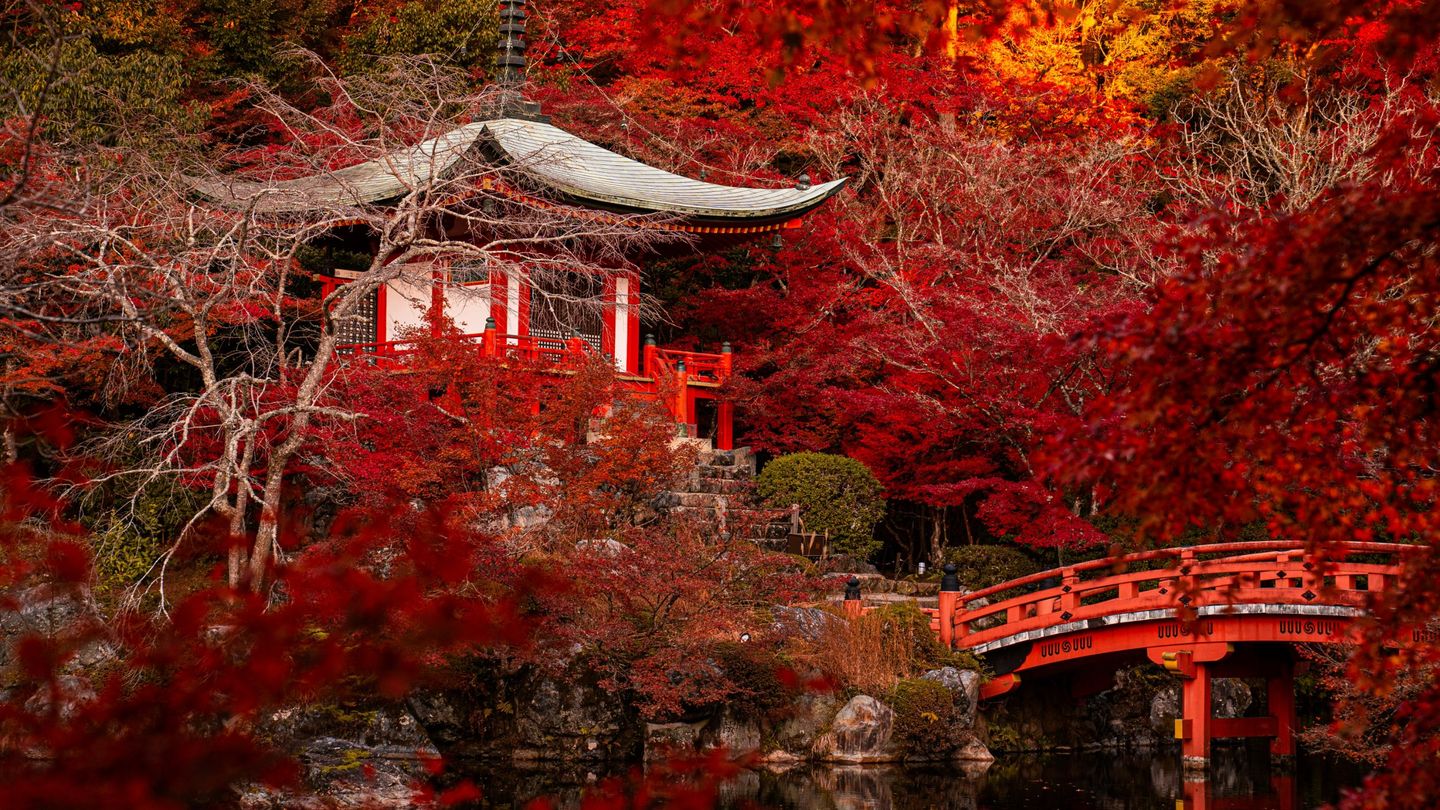
Ask most people when to visit Japan and they’ll say cherry blossom season. Ask a lot of photographers and you’ll get a different answer: autumn. For a few weeks the maples turn deep red, the ginkgo trees go bright yellow, and the temples, gardens and mountains are framed in colour. The weather is usually settled too, with clear, crisp days that are perfect for walking.
I haven’t been to Japan yet, so like my guide to cherry blossom in Japan, this is a researched guide rather than a trip report, written with a photographer’s eye. It covers when the colours arrive, how to follow the forecasts and the places I’d most want to see, from the mountains of Hokkaido to the temples of Kyoto.
What is koyo?
Koyo simply means the autumn leaves changing colour, and going out to look at them has its own name, momijigari, which roughly translates as hunting for red leaves. Momiji is the Japanese maple, and its small, star-shaped leaves turn the deepest red. Alongside them, the fan-shaped leaves of the ginkgo trees turn a brilliant yellow, and the two together line streets, parks and temple gardens across the country.
It’s taken just as seriously as hanami in spring. Temples run evening light-ups, trains get busier at weekends, and the news reports on how the colours are progressing.
When is autumn leaf season in Japan?
Autumn moves the opposite way to the cherry blossom, starting in the cold north and the high mountains and working its way south and down towards sea level. As a rough guide, based on typical years:
- Hokkaido: the mountains of Daisetsuzan from mid to late September, the lower areas through October.
- Tohoku and the Japanese Alps: October, earlier at altitude.
- Nikko: the high lakes and waterfalls in early to mid October, the town in late October to early November.
- Mount Fuji and Hakone: late October to mid November.
- Tokyo: late November to early December.
- Kyoto and Osaka: mid November to early December.
- Hiroshima and Miyajima: mid to late November.
The peak in any one spot lasts around a week or two, and recent years have tended to run late, as warmer autumns hold back the colour. If your trip is fixed, the second half of November is usually the safest bet for Kyoto and the surrounding area.
How do the autumn leaf forecasts work?
Just like in spring, Japanese weather companies such as the Japan Meteorological Corporation and Weathernews publish autumn leaf forecasts, with predicted start and peak dates for popular spots across the country. They usually appear from late summer and are updated through the season, and English versions are easy to find online.
I’d use them to fine-tune rather than to plan from scratch. Book your trip around the typical dates, then check the forecasts a couple of weeks out and shuffle the order of your stops if you need to. Because the colours move down from the mountains, a route that starts higher up and finishes in the cities gives you a good chance of catching the peak somewhere.
The best places to see autumn leaves in Kyoto
Kyoto is the classic autumn destination, with hundreds of temples and gardens and maples planted around almost all of them. It’s also extremely busy in November, so pick a few favourites and go early.
Tofuku-ji
Tofuku-ji is famous for the view from its wooden Tsutenkyo bridge over a valley filled with around two thousand maple trees. At the peak it’s one of the most popular sights in the city, and photography from the bridge itself is restricted at the busiest times, so arrive as it opens.
Eikando
Eikando’s temple buildings climb a hillside, and the maples around its pond and pagoda are some of the most celebrated in Kyoto. It’s best known for its evening illuminations, when the trees glow red against the dark sky.
Daigo-ji
In the south-east of the city, Daigo-ji is a huge temple complex that climbs a forested mountain. Its red Bentendo hall and arched bridge, reflected in a pond and surrounded by maples, is one of the most photographed autumn scenes in Kyoto, and it’s quieter than the temples in the centre. It’s a short walk from Daigo station on the Tozai subway line.
Kiyomizu-dera and Arashiyama
The huge wooden stage at Kiyomizu-dera looks out over a hillside of red and orange, and the temple also opens in the evenings for illuminations during the season. On the other side of the city, Arashiyama’s riverside hills turn to colour, and the quieter temples above the bamboo grove, such as Jojakko-ji, are well worth the walk.
Autumn leaves around Osaka and Nara
If you’re basing yourself in Kyoto, Osaka and Nara are easy add-ons, and both have their own autumn colour. Nara Park’s maples and ginkgo trees frame the temples and the famous deer, and Todai-ji and the Isuien garden are lovely at this time of year.
Just north of Osaka, Minoo Park follows a forested valley up to a waterfall, around 3 kilometres from the station, and the walk is lined with maples. The local speciality is even made from them: momiji tempura, maple leaves fried in a sweet batter and sold from stalls along the path. It’s an easy half day out of the city and much less busy than the big Kyoto temples.
The best places to see autumn leaves in Tokyo
Tokyo’s colours arrive late, often lasting into early December, which makes it a good end to a trip that started further north.
- Meiji Jingu Gaien: an avenue of around 150 ginkgo trees that turns into a tunnel of gold, usually from late November.
- Rikugien: a traditional Edo-period garden with evening illuminations of its maples during the season.
- Shinjuku Gyoen: a huge mix of maples, ginkgo and plane trees, and plenty of space to escape the crowds.
- Mount Takao: an easy hike from the city, around an hour by train, with colourful woods and, on a clear day, views towards Mount Fuji.
Beyond the cities: Nikko, Mount Fuji, Hokkaido and Miyajima
Nikko
Nikko is around two hours from Tokyo, and it combines ornate shrines with dramatic mountain scenery. The colours start up high around Lake Chuzenji and the Kegon Falls, then work their way down the hairpin bends of the Irohazaka road to the town. It’s a very popular weekend trip, so go midweek if you can, and allow extra time for traffic on the mountain road.
Mount Fuji and the Fuji Five Lakes
Lake Kawaguchiko holds an autumn leaves festival each November, and its so-called maple corridor along the northern shore is lit up in the evenings. On a clear morning, the combination of red leaves, a still lake and a snow-capped Fuji is about as Japanese a view as you can get. Mornings give you the best chance of the mountain being out of the cloud.
Hokkaido
Daisetsuzan National Park, in central Hokkaido, is the first place in Japan to see autumn colour, with the slopes turning red and gold from mid September. It’s a great choice if you’re travelling early in the season and like walking, with cable cars and trails into the mountains. The colours then move down to the hot spring towns, such as Jozankei near Sapporo, in October.
Kanazawa
Kanazawa, on the Sea of Japan coast, is an easy trip by bullet train from Tokyo and makes a good alternative to the Kyoto crowds. Its Kenrokuen garden is considered one of the three great gardens of Japan, and from early November the gardeners tie the pine trees up with ropes, called yukizuri, to protect the branches from the weight of winter snow. Combined with the autumn maples, it’s a lovely and very Japanese sight, and the old geisha and samurai districts nearby are well worth an afternoon.
Miyajima
The island near Hiroshima is home to Momijidani Park, the valley of maples, which sits just behind Itsukushima Shrine and its famous floating gate. The island’s favourite snack is even a maple-leaf shaped cake, momiji manju. It fits neatly onto the end of the classic route I set out in my two-week Japan itinerary.
How to plan a Japan trip for autumn colours
November is one of the busiest months of the year in Kyoto, and the best hotels go early, so I’d book as far ahead as you can, with free cancellation if possible. Weekends are much busier than weekdays at the famous spots, and so is the national holiday on 23 November.
The weather is usually one of autumn’s biggest advantages, with mild, dry days and cool evenings, but September and early October can still bring typhoons, so build a little flexibility into the early part of a trip. Pack layers, as mornings in the mountains can be cold.
For a two-week trip in November, I’d start in the mountains or around Mount Fuji, spend the middle of the trip in Kyoto, Nara and Osaka, and finish in Tokyo, where the colours often last into December.
How to photograph Japan’s autumn leaves
Look for backlight
Maple leaves are thin, so when the sun shines through them from behind they glow like stained glass. Stand under the trees and shoot towards the light, with something dark behind the leaves, such as a temple roof or a shaded hillside, to make the colour stand out.
Use reflections and the ground
Ponds, rivers and even puddles double the colour, and the fallen leaves on moss, stone steps and temple paths make lovely detail shots once the peak has passed. A polarising filter, if you use a camera, cuts the glare on the leaves and deepens the colour.
Go back after dark
The evening light-ups at temples like Eikando and Kiyomizu-dera are magical, but many of them don’t allow tripods, so you’ll be shooting handheld. Brace yourself against something steady and raise the ISO, and my guide to night photography for beginners covers the settings.
Frequently asked questions
When is the best time to see autumn leaves in Japan?
It depends on where you go. The colours start in the mountains of Hokkaido in mid September and reach Tokyo and Kyoto from mid to late November, often lasting into early December. For a first trip focused on Kyoto, Nara and Osaka, the second half of November usually gives you the best chance of seeing the peak.
Where is the best place to see autumn leaves in Japan?
Kyoto is the classic choice, with temples like Tofuku-ji, Eikando and Kiyomizu-dera surrounded by maples. Nikko, Lake Kawaguchiko near Mount Fuji and Daisetsuzan in Hokkaido are great for mountain scenery, and Tokyo’s ginkgo avenue at Meiji Jingu Gaien turns gold in late November. Miyajima, near Hiroshima, is lovely too.
What is koyo in Japan?
Koyo is the Japanese word for the autumn leaves changing colour, and momijigari, or hunting for red leaves, is the tradition of going out to see them. Momiji is the Japanese maple, which turns deep red, while the ginkgo trees turn bright yellow. Temples, parks and gardens across Japan are at their most colourful during the season.
Is November a good time to visit Japan?
November is one of the best months to visit, with mild, mostly dry weather and the autumn colours at their peak in Kyoto, Osaka and around Mount Fuji. It’s also very popular, especially in Kyoto, so book hotels early and visit the famous temples first thing in the morning or on weekdays to avoid the worst of the crowds.
Is autumn or spring better for visiting Japan?
Both are wonderful. Spring has the cherry blossom, which lasts only a week or so in any one place, while autumn colour usually lasts longer and the weather is often more settled. Autumn is generally a little less expensive and less frantic than peak blossom season, so it’s a great choice if your dates are flexible.